Soundproofing Panels: What Actually Blocks Noise and What Just Cuts Echo
Updated
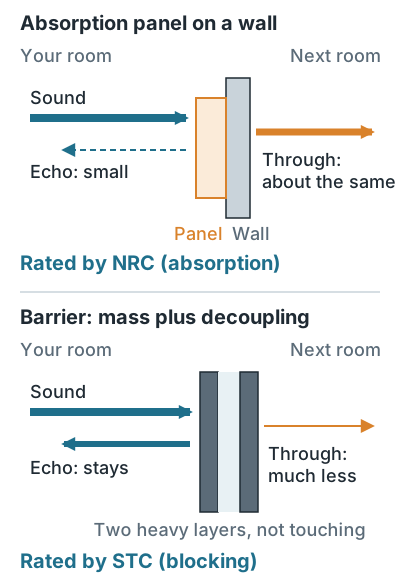
Let's clear something up first. Foam, fiberglass and felt soundproofing panels are absorbers. They soak up echo inside your room. They don't do much about sound coming through the wall. You can hang a panel rated NRC 1.00 and still hear every word of the neighbor's TV. Blocking noise between rooms takes mass, decoupling, damping and sealed gaps. So figure out which problem you've got, then pick the panel that fixes it.
Echo or noise through the wall: which one's bugging you?
Think of it this way. If the sound starts in your room and bounces around (echo on calls, boomy voices, harsh music), you absorb it with panels. If it's coming from another room or from outside, you have to block it. Those are two different jobs. They use different materials and different ratings: NRC for absorbing, STC for blocking. Acoustic panels vs soundproofing lays both scales out side by side.
Echo in your room
Absorb
Foam, fiberglass or felt panels, compared by NRC. Fixes echo on calls, boomy living rooms and harsh home studios.
Noise from next door
Block
Mass, decoupling, damping and sealing, compared by STC. Panels stuck on the surface barely help.
Interactive
Echo or noise?
Answer three questions to find the fix for your room.
One question decides what you need: where does the sound start?
- In your room (echo on calls, a boomy room): absorb it with acoustic panels. Start with what acoustic panels do and how many you need.
- Next door or outside (voices, TV, traffic): block it. Seal the gaps first, then add mass and decoupling. See panels and noisy neighbors.
- Footsteps upstairs: footsteps travel through the floor framing, and a ceiling panel adds almost nothing to stop them. The fix is a new ceiling that doesn't touch the joists. See panels on ceilings.
- Both (home studio or theater): a theater needs blocking built before the panels go up; most home studios need treatment first and isolation only if the neighbors or outside noise are a problem. See acoustic panels vs soundproofing.
- Renting? Renters get the most from panels that come off without damage, plus a few cheap seals at the door and outlets. See renter-friendly options.
Based on: Acoustic Panels vs Soundproofing, Do Soundproofing Panels Work for Noisy Neighbors?, Do Soundproof Panels Work on Ceilings?
Types of soundproof wall panels
Soundproof wall panels come in two families. Absorbers list an NRC on the data sheet. Mass barriers list an STC or a weight per square foot. If a product page gives you neither number, the word "soundproof" is just marketing.
| Type | Maker's rating | What it does | Full guide |
|---|---|---|---|
| Acoustic foam | NRC 0.50 (1 in.) to 1.10 (4 in.), Auralex Studiofoam Wedge (opens in a new tab) | Soaks up mids and highs. Light and cheap | Soundproof foam panels |
| Fiberglass or mineral wool board | NRC 0.70 (1 in.) and 1.00 (2 in.), Owens Corning 703 (opens in a new tab); 1.10 for 3 in. Rockwool Safe'n'Sound (opens in a new tab) | Higher NRC than foam of the same thickness | Fiberglass and mineral wool panels |
| Fabric-wrapped panel | NRC 1.00 for a 2 in. Primacoustic Broadway panel (opens in a new tab) (Riverbank lab test) | A fiberglass core with a fabric face, for finished rooms | Decorative soundproof panels |
| PET felt | NRC 0.45 for 12 mm mounted flat, Acoufelt (opens in a new tab) | Thin, printable, soaks up mostly highs | Decorative soundproof panels |
| Wood slat | Depends on the felt or fiber behind the slats | Mostly a finish. The backing does the absorbing | Wood soundproof panels |
| Mass loaded vinyl | STC 26 at 1 lb/sq ft, Johns Manville (opens in a new tab) | Blocks when it's built into a wall or sealed at the edges | MLV soundproofing panels |
| Soundproof drywall and fiberboard | Rated as part of a full wall assembly | Adds mass and damping to a wall | Soundproof drywall panels, Sonopan review |
| Styrofoam (EPS) | Sold as thermal insulation | Not an acoustic product | Why styrofoam panels fail |
Stuck between foam and fiberglass at the same thickness? See acoustic panels vs foam.
Absorption panels: what they're actually good for
Absorption panels cut down echo and reverb in the room they hang in. An NRC of 1.00 means the panel soaks up nearly all the mid-range sound that hits it. They're the right buy for a home office, a video-call room, a living room with hard floors or a home studio. What acoustic panels do gets into the details.
NRC is just an average. It takes a material's absorption at 250, 500, 1,000 and 2,000 Hz and rounds to the nearest 0.05 (Acoustical Society of America terminology (opens in a new tab)). Notice what's missing: the bass. So NRC tells you nothing about how a panel handles a kick drum or a subwoofer.
| Thickness | Absorption at 125 Hz | NRC |
|---|---|---|
| 1 in. | 0.05 | 0.70 |
| 2 in. | 0.15 | 1.00 |
| 4 in. | 0.56 | 1.15 |
Panels do the most work at the first reflection points. Those are the spots on the side walls where sound from your speakers, or your voice, bounces straight to your ears. Finding them is easy. Sit where you usually sit, have someone slide a mirror along the wall, and mark every spot where you can see a speaker (Primacoustic (opens in a new tab)).
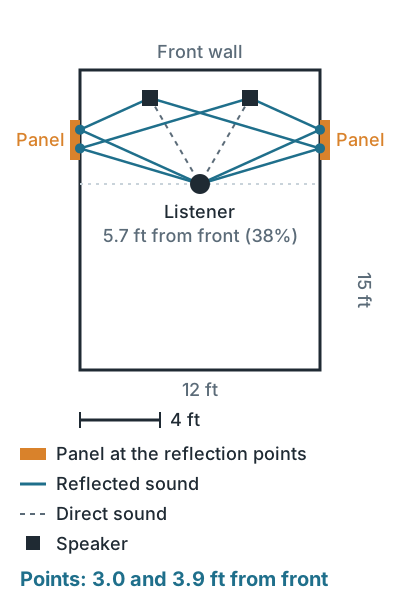
You don't need to cover whole walls. Primacoustic says covering most of the reflection area gives "plenty of control." The counts for a whole room are in how many acoustic panels you need and whether to cover the entire wall.
Interactive
Echo time estimator
See how panels change how long a clap rings in an empty room.
Echo time (RT60) = 0.049 × room volume in cu ft ÷ total absorption in sabins (Sabine formula, University of Illinois (opens in a new tab)). In a bare 12 by 15 ft room with an 8 ft ceiling, every surface at drywall's 0.05 gives 792 × 0.05 = 39.6 sabins and an echo time of 1.8 s. Eight 2 by 4 ft panels of 2 in. fiberglass (NRC 1.00) bring it to 0.7 s; six bring it to 0.8 s.
Based on: Do Acoustic Panels Work?, What Do Acoustic Panels Do?
Why absorption panels don't block noise
A 2 in. fiberglass panel weighs about 0.5 lb/sq ft. Blocking sound comes down to weight and to keeping a wall's layers apart. Absorption doesn't really enter into it. And even weight gets you less than you'd hope. For a single layer, the mass law gives you only about 6 dB more transmission loss each time the weight per square foot doubles (NRC Canada, CBD-239 (opens in a new tab)).
Example: In USG lab tests (opens in a new tab), a full second layer of 5/8 in. Firecode X drywall on one side of an insulated 2x4 wall took it from STC 34 to 37. That layer weighs 2.2 lb/sq ft (USG (opens in a new tab)). A 2 in. panel of 3.0 lb/cu ft fiberglass weighs 3.0 × 2 ÷ 12 = 0.5 lb/sq ft. That's less than a quarter of the drywall, so expect well under 3 points from it.
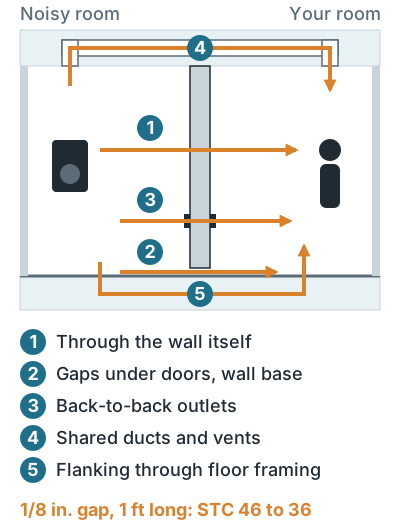
Panels also don't touch the real leaks. Sound is like water: if there's a gap, it'll find it. Gaps under doors, outlet boxes and shared ducts all carry sound right around the wall. Do soundproof panels work? gives the short answer, and how soundproof panels work gets into the physics.
What actually blocks sound: mass, decoupling, damping, sealing
There are four ways to block sound: mass, decoupling, damping and airtight seals. Decoupling punches way above its weight. In USG's tests on that same 2x4 wall, resilient channel on one side added 14 STC points. That's almost five times what the extra layer of drywall did.
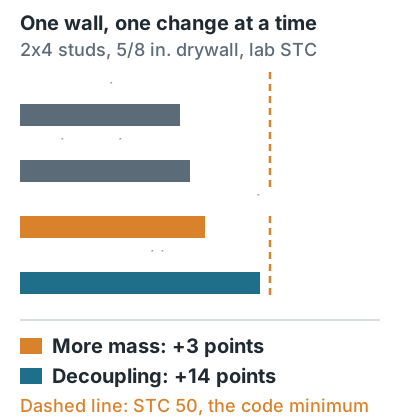
- Mass: heavier stuff blocks more. Johns Manville's vinyl barrier rates STC 26 at 1 lb/sq ft and STC 31 at 2 lb/sq ft (data sheet (opens in a new tab)); see MLV soundproofing panels.
- Decoupling: stop the two faces of the wall from touching through the studs. That's the whole point of resilient channel, staggered studs and double stud walls. NRC Canada (opens in a new tab) calls rigid connections "the acoustical equivalent of an electrical short circuit."
- Damping: a viscoelastic layer sandwiched between two stiff sheets soaks up vibration. QuietRock builds this constrained-layer damping right into one board (PABCO Sound Design Guide (opens in a new tab)); see soundproof drywall panels.
- Sealing: the cheap one, and it matters more than you'd think. In PABCO's example, an unsealed 1/8 in. gap 1 ft long drops a wall from STC 46 to 36. Run acoustical caulk along the wall base, seal the outlet boxes and put sweeps on the doors.
Rule: Absorb what's made in the room. Block what comes from outside it. Seal the gaps before you buy either.
Sound also sneaks around the wall, so the weak spot is often a door, a window or the ceiling and not the wall itself. The fixes for each are in soundproof door panels, soundproof window panels and soundproof ceiling panels.
How to choose the best soundproofing panels for your room
Go by where the noise starts. Rooms with echo, like offices and studios, need absorbers. Bedrooms and apartments that hear the neighbors need mass and sealing.
Bedroom
Seal, then block
Noise usually sneaks under the door and through the shared wall. Bedroom wall panels
Apartment
Seal first
Door gaps first, then mass you can take with you when you move. Renter-friendly options
Home office
Absorb
Echo on calls and voices carrying between desks. Office soundproofing panels
Home studio
Both
Treat the room for clean recordings, isolate it for the neighbors. Studio soundproofing panels
Home theater
Both
Block the bass leaving the room and absorb the reflections inside it. Home theater panels
Ceiling
Depends
Echo needs absorbers up there. Footsteps need a decoupled ceiling. Ceiling panels
Door
Seal, then mass
Sweep and gaskets first, then a heavier slab or panel. Door panels
Window
Plug
A heavy insert sealed into the frame. Window panels
Yard or patio
Block
Solid, heavy barriers with no gaps. Outdoor panels
Pickleball court
Block
Barriers on the fence line between the court and the houses. Pickleball panels
What to expect once they're up
Absorption panels make a room sound less echoey the day you hang them. A neighbor's voice through the wall, though? About the same. Blocking upgrades are measured in STC points, and it takes a 10 dB drop for a sound to seem half as loud (National Insulation Association (opens in a new tab)).
| Wall STC | Loud speech from next door |
|---|---|
| 30 | Fairly well understood |
| 35 | Audible but not intelligible |
| 45 | Some barely audible |
| 50 | Not audible |
STC 50 is also the building code minimum for walls and floors between dwelling units, or 45 when it's tested in the field (Los Angeles Department of Building and Safety, IBC Section 1206 (opens in a new tab)). USG's insulated 2x4 wall at STC 34 falls 16 points short.
FAQ
Do thin panels absorb bass?
Barely. Below 250 Hz, absorption climbs steeply with thickness. So if bass is your problem, go 4 in. thick or more. NRC alone won't tell you how a panel does on bass.
Can one panel both absorb and block?
Only if it pairs an absorber face with a heavy backing like mass loaded vinyl, covers the whole wall and has sealed edges. Separate panels with gaps between them leak around the edges, so they don't block much.
Will ceiling panels stop footsteps from upstairs?
No. Footsteps are impact noise. They travel through the floor framing and get rated by IIC, not STC (code minimum IIC 50 between units). You need a decoupled ceiling or a fix on the floor upstairs; see do soundproof panels work on ceilings.
Should I seal gaps before buying panels?
Yes. Sealing is the cheapest fix, and one unsealed gap can wipe out 10 STC points of a good wall. Caulk, door sweeps and outlet gaskets come before any panel. More questions are answered in the soundproof panels FAQ.
Guides in Soundproof Panels
Soundproof Wall Panels for Bedrooms: What Helps You Sleep
Soundproof wall panels for a bedroom cut echo, not a neighbor's TV. Here's which panels to buy, renter-safe mounting, and what really stops noise at night.
Soundproof Foam Panels: What They Absorb, What They Don't Block
Soundproofing panels foam cuts echo (NRC 0.50 to 1.10) but blocks almost no noise. Real data by thickness, wedge vs hexagon, density and fire ratings.
Soundproof Ceiling Panels: What Fixes Echo and What Stops Upstairs Noise
Soundproof ceiling panels cut echo but not footsteps from upstairs. Compare clouds, tiles and boards by NRC, and see what really stops noise from above.
MLV Soundproofing Panels: When Mass Loaded Vinyl Works
MLV soundproofing panels block sound with mass: 1 lb/sq ft vinyl rates STC 26. See where mass loaded vinyl works, where it's wasted, and what a roll weighs.
Soundproof Acoustic Wood Wall Panels: Do Slat Walls Block Sound?
A soundproof acoustic wood wall panel soaks up echo through its felt backing (NRC 0.55 to 0.95) but barely blocks noise. Lab data, mounting and what to buy.
Soundproof Panels With Art: Decorative, Felt and Custom Prints
A soundproof panel with art cuts echo just as well as a plain one with the same core: NRC 1.00 at 2 in. Compare art, felt, white and black panels by the data.
Fiberglass and Mineral Wool Soundproof Panels: OC 703 vs Rockwool
Fiberglass soundproof panels compared: OC 703, 705 and Rockwool density, NRC by thickness and fire ratings, plus what they do and don't block inside a wall.
Soundproof Door Panels: What Works on a Thin Door
A soundproof door panel can't fix a door that leaks at the edges. Lab STC data for sealed vs unsealed doors, what panels add, and the order to fix a door in.
Soundproof Window Panels and Plugs: What Blocks Street Noise
A soundproof window panel only works sealed inside the frame with an air gap. Compare plugs, inserts and storm windows by STC, and what to expect from traffic.
Outdoor Soundproof Panels and Fence Barriers: What Cuts Yard Noise
Soundproof outdoor panels only work as solid, heavy barriers that break the line of sight. See FHWA rules on height, weight and length, and fence panel options.
Pickleball Soundproofing Panels: Fence Wraps, Barriers and What Neighbors Notice
Soundproofing panels for pickleball cut the pop, not the game, if they're tall, heavy and gap-free. See study data, setbacks, fence wraps and glass panels.
Office Soundproofing Panels: Privacy, Echo and Glass Partitions
Office soundproofing panels fix echo; speech privacy needs STC 40 to 45 walls built to the deck. GSA targets, glass partition STC data and warehouse panels.
Studio Soundproofing Panels: Treatment vs Isolation
Studio soundproofing panels fix how your room sounds, not what the neighbors hear. Here's where each panel goes, how thick for bass, and what isolation takes.
Home Theater Soundproofing Panels: Where They Go and What They Can't Stop
Soundproof panels for home theater tame reflections inside the room, but bass reaching the bedrooms needs sealing and decoupling. See where panels go and why.
Soundproofing Panels for Apartments: Renter-Friendly Options
Soundproofing panels for apartments cut echo but barely touch neighbor noise. Renter-safe mounting, self-adhesive and freestanding options, and what helps.
Soundproof Drywall Panels: QuietRock and the Alternatives
Soundproof drywall panels like QuietRock 510 rate STC 49 on one side of a 2x4 wall. Compare damped board with double drywall and Green Glue by weight and STC.
Sonopan Soundproofing Panels Review: What the STC Ratings Mean
Sonopan soundproofing panels are 3/4 in. wood fiberboard rated STC 27 alone and STC 50 to 58 in the maker's walls. See what the data shows and how to install.
Styrofoam Soundproofing Panels: Why They Don't Work
Styrofoam soundproofing panels fail twice: closed cells reflect sound instead of absorbing it, and 1 in. board weighs 0.075 lb/sq ft. Here's what to use.
Comparisons
Comparison
Acoustic Panels vs Soundproofing: The Difference That Saves You Money
Acoustic panels vs soundproofing: panels soak up echo in a room (NRC), soundproofing blocks noise between rooms (STC). Real numbers, and which one you need.
Comparison
Acoustic Panels vs Foam: Which One Cuts Noise More?
Acoustic panels vs foam: fiberglass absorbs more per inch (NRC 1.00 vs 0.75 at 2 in.) and has a better fire rating. Neither blocks noise. Data and costs.
Soundproof Panels FAQ
64 questions, answered
- Does it work?6
- How they work2
- Materials4
- Placement and coverage8
- Installation10
- DIY1
- Cost and buying4
- Foam2
- Pros and cons3
- Wood and slat walls2
- Mass loaded vinyl3
- Ceilings4
- Cheap fixes4
- Neighbors and apartments5
- Safety and specs6