Soundproof Window Panels and Plugs: What Blocks Street Noise
Updated
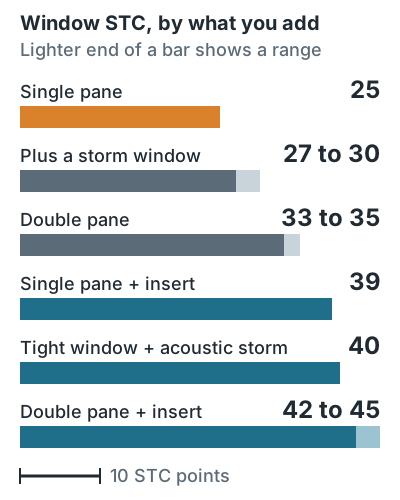
A soundproof window panel works when it adds a second sealed layer inside the window frame, with an air gap behind it. Indow rates a single-pane window at STC 25 and the same window with its acoustic-grade insert, 3 in. from the glass, at STC 39. Acoustic panels or curtains hung near the window? They'll absorb echo, but street noise stays almost the same.
Why the window is the weak spot
Windows let in more noise than the walls around them, so they set the limit for the whole room. Think of a chain: it's only as strong as its weakest link. The Metropolitan Airports Commission, which insulates homes near Minneapolis airport, says homes in cold climates cut outdoor noise by 27 to 30 dB as built, and that acoustical windows improve on that more than any other change (MAC sound insulation tips (opens in a new tab)).
Bigger windows make it worse. MAC notes that the more of a wall the glass covers, the lower the wall's overall noise protection.
Soundproof window panels compared: plugs, inserts, storms
Soundproof panels for windows come in four forms. The main differences are whether you can still see out and how well they seal.
| Option | Rating | Keeps the view? | Best for |
|---|---|---|---|
| Window plug (dense board in the opening) | No lab rating; depends on weight and seal | No | Bedrooms at night, home studios |
| Acrylic or glass insert | STC 39 over single pane, 42 to 45 over double (Indow (opens in a new tab)) | Yes | Renters, street-facing living rooms |
| Acoustic storm window | STC 40 over a tight window (MAC (opens in a new tab)) | Yes | Owners near highways or airports |
| Laminated glass in a new window | 1/2 in. glass STC 36 alone; laminated 9/16 in. STC 39 (Viracon (opens in a new tab)) | Yes | Window replacement anyway |
| Acoustic panel or curtain near the window | Absorbs (NRC), doesn't block | Depends | Echo only |
Airport sound insulation programs go by the same targets. The Reno-Tahoe Airport Authority asks for replacement windows rated at least STC 40 and storm windows at least STC 30 (RTAA guide (opens in a new tab)).
How to build a window plug
A window plug is a heavy, airtight board you press into the window opening at night. It's 5/8 in. drywall at 2.2 lb/sq ft (USG (opens in a new tab)) for mass, faced with 2 in. fiberglass board at 0.5 lb/sq ft to soak up the sound trapped between the plug and the glass.
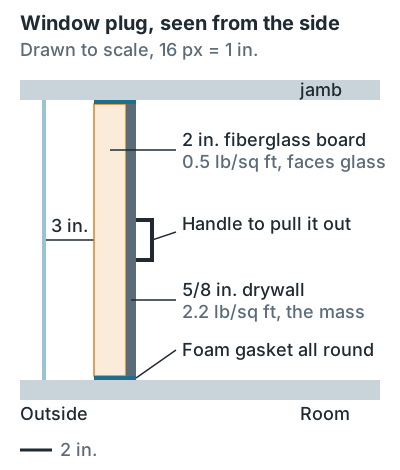
- Measure the opening at the top, middle and bottom, inside the jambs. Cut the plug to the smallest width and height less 1/4 in. so the gasket can close the gap.
- Cut the layers: one piece of 5/8 in. drywall and one of 2 in. fiberglass board, both to that size.
- Bond them with construction adhesive, fiberglass facing the glass, and wrap the fiberglass face in fabric so it doesn't shed fibers.
- Fit a gasket of closed-cell foam weatherstrip around all four edges so the plug presses tight against the jambs.
- Add handles on the room side, then press the plug in until it sits about 3 in. from the glass with the gasket squeezed tight all the way around.
Example: A 36 by 48 in. window is 36 × 48 ÷ 144 = 12 sq ft. The drywall weighs 12 × 2.2 = 26.4 lb and the fiberglass 12 × 0.5 = 6 lb, so the plug weighs about 32 lb. Handles on both sides make that manageable for one person at a window you can reach standing.
A plug blocks the window as a way out in a fire. In a bedroom, make sure you can pull it out by hand in seconds. Never screw it in, and leave it out when nobody's in the room.
Why the air gap matters
The space between the glass and the panel does a lot of the work. For double glazing, NRC Canada found STC rises about 3 points each time the air space doubles (CBD-240, Sound Transmission Through Windows (opens in a new tab)). With a really small gap, two layers can end up working no better than one.
- Mount the panel deep: a plug or insert at the room side of a deep sill gives you a bigger gap than one pressed up close to the glass.
- Seal every edge: CBD-240 puts a well-weatherstripped opening window 3 to 5 STC points below the same window sealed shut, and the loss grows as the sealed rating goes up.
- Line the gap: absorbent material around the edge of the cavity adds only a little to STC, though NRC Canada measured gains up to 10 dB at high frequencies.
Traffic noise: what to expect
A sealed window panel will cut the hiss and voices from the street a lot more than the rumble of trucks and buses. CBD-240 notes that STC underrates low-frequency sources like road traffic and aircraft. That's why glass makers also publish OITC, an outdoor-traffic rating that comes out lower for every glass below.
| Glass | STC | OITC |
|---|---|---|
| 1/4 in. single pane | 31 | 29 |
| 1 in. double-pane unit (1/4 in. glass, 1/2 in. space) | 35 | 30 |
| 1 1/16 in. double-pane unit with one laminated lite | 41 | 32 |
A 10 dB drop sounds about half as loud (National Insulation Association (opens in a new tab)), so going from a single pane at STC 25 to an insert at 39 is a change you'll clearly notice, though the bass is still there. Panels that only absorb won't get you there, as do acoustic panels help with outside noise explains.
Before you spend more on the window, check the rest of the room. Vents, a through-wall air conditioner and the door all leak too. The soundproof panels guide maps every path noise takes into a room.
FAQ
Do soundproof curtains work as window panels?
Not for blocking. A curtain is light and leaves gaps at the edges, so it trims echo and a bit of high-frequency noise, but it's nowhere near the 14 points an insert adds over a single pane.
Can I leave a window plug in all day?
You can, but the room gets no daylight or fresh air, and in a bedroom the window stays blocked as an escape route. Pull it out whenever the room's empty.
Is replacing windows better than adding inserts?
Only if the new window is acoustically rated. Indow rates a standard double-pane window at STC 33 to 35 and a single pane with its acoustic insert at 39; the Reno-Tahoe program asks for STC 40 or better when it replaces windows.
How far from the glass should a window panel sit?
As far as the frame lets you. Indow's STC 39 rating uses a 3 in. gap, and NRC Canada found each doubling of the air space adds about 3 STC points. There are more answers in the soundproof panels FAQ.