Soundproof Door Panels: What Works on a Thin Door
Updated
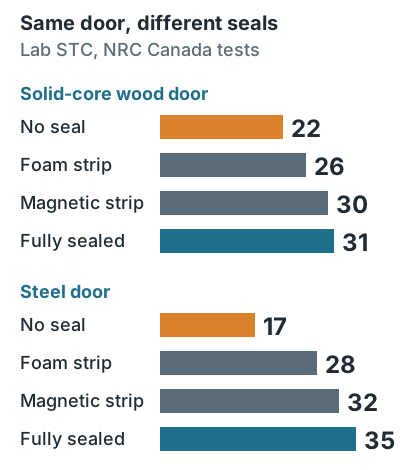
A soundproof door panel is the last thing a thin door needs, not the first. A lot of the noise sneaks through the gaps around the slab. In NRC Canada lab tests, sealing the edges of a solid-core wood door raised it from STC 22 to 31 without touching the slab. So seal the gaps, then add mass with a heavier slab or a vinyl panel. Foam door panels? Those are for echo control only.
Why a thin door leaks: the gaps matter more than the slab
A door with open gaps rates about STC 17 to 22 no matter what it's made of, and seals alone add 9 to 18 points. J.D. Quirt measured both ends for NRC Canada (Sound transmission through double doors, Canadian Acoustics, 1986 (opens in a new tab)). With no seals, the wood door only beat the steel one because its cracks were about a third as wide.
Example: In PABCO's example (opens in a new tab), an unsealed 1/8 in. gap 1 ft long (1.5 sq in.) drops a wall from STC 46 to 36. A 1/2 in. gap under a 32 in. door is 0.5 × 32 = 16 sq in., more than ten times that opening.
A panel glued to the face of the door doesn't cover any of that. Sound just walks right around it.
Types of soundproof door panels
The soundproof door panels you'll find online come in two groups: light absorbers that cut echo, and heavy barriers that add mass. Only the heavy ones change what gets through, and only on a door that's already sealed.
| Panel type | What it adds | Blocks noise through the door? |
|---|---|---|
| Foam or fabric acoustic panel | Absorption (NRC); about 0.5 lb/sq ft at 2 in. of fiberglass | Barely; cuts echo on your side |
| Mass loaded vinyl sheet | 1 lb/sq ft; STC 26 on its own (Johns Manville (opens in a new tab)) | Some, if it covers the whole slab and the edges are sealed |
| Heavy blanket over the door | Mass plus a soft face, hung on hooks | Some, if it overlaps the frame on all sides |
| Solid-core slab (replaces the door) | Mass through the whole door | Yes, with seals |
Is an absorber worth sticking on a door for echo, and how do you mount one without wrecking the paint? That's answered in can you put acoustic panels on a door.
Seal the door first
Sealing gave the biggest jump in both of NRC Canada's single-door tests: 9 points for wood and 18 for steel. GSA's office acoustics guide calls for continuous closed-cell foam seals on three sides of a door, and rates hollow-core doors "only good to poor" (GSA Sound Matters (opens in a new tab)).
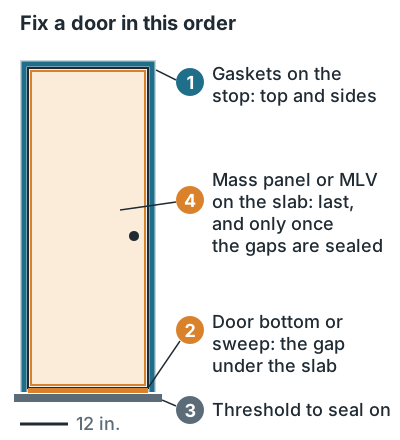
- Find the leaks: at night, turn off the lights on the quiet side and look for light at the top, sides and bottom. If light gets through a gap, so does sound.
- Gasket the stop: put compression gaskets along the top and both sides where the door closes against the stop, so the slab presses into them all the way around.
- Close the bottom: add an automatic door bottom or a sweep that touches the floor across its full width.
- Add a threshold: on carpet or an uneven floor, put in a threshold so the bottom seal has a flat, hard surface to press against.
- Check the latch: if the door doesn't close firmly against the gaskets anymore, adjust the strike plate until it does.
Add mass: panel on the door or a solid-core door?
Once the edges are sealed, the slab turns into the weak spot, and the only way to make it better is more weight. Each doubling of weight per square foot adds about 6 dB of transmission loss for a single layer (NRC Canada, CBD-239 (opens in a new tab)).
Vinyl panel on the slab
+1 lb/sq ft
A 30 by 80 in. door is 30 × 80 ÷ 144 = 16.7 sq ft, so a full sheet adds about 17 lb. Keep it inside the stop so the door still closes on its gaskets.
Solid-core door
STC 31 sealed
That's NRC Canada's sealed solid-core wood door. Swapping the slab keeps the door looking normal and reuses your new seals.
Watch out: A panel that stops short of the edges, or a blanket hung with gaps at the sides, leaves the weakest part of the door alone. Mass only counts where it covers the whole opening.
Before you hang a heavy sheet on a hollow door, make sure the hinges are rated for the extra weight, and plan on a third hinge if the door starts to sag.
Best door fix for your budget
Seals are the cheapest fix, and a second door is the biggest. Quirt's two-door tests reached STC 47 with a 2.5 in. (65 mm) space between sealed doors and STC 52 to 54 with a 9 in. (228 mm) space, past the STC 50 that building code sets for walls between apartments (opens in a new tab).
Rental, thin door
Seal
Stick-on gaskets and a sweep come right off when you move. Hang a heavy blanket over the door at night.
Bedroom or office
Seal, then solid core
Seals first. If voices still come through, swap a hollow-core slab for solid core.
Home studio or theater
Two doors
A second sealed door with an air space gets into the 47 to 54 range in lab tests.
Echo in a hallway
Absorb
Acoustic panels on the door or walls help with this, not with noise from the next room.
If the door is just one of several leaks, the soundproof panels guide shows the other paths noise takes between rooms and what blocks each one.
FAQ
Is a solid-core door enough without seals?
No. The solid-core wood door in NRC Canada's tests rated only STC 22 with no seals and 31 fully sealed. The seals did more than the slab did.
Do steel doors block more sound than wood?
Only when they're sealed. The steel door tested at STC 17 unsealed and 35 fully sealed, against 22 and 31 for the wood door.
Will a door sweep alone fix noise from the hallway?
It only fixes the gap at the bottom. If you see light at the top or sides, you need gaskets there too. Otherwise the sound just moves over to those gaps.
Do soundproof door panels need to cover the whole door?
Mass panels do, edge to edge inside the stop, because any strip you leave uncovered will leak. Absorption panels for echo can be any size. There are more answers in the soundproof panels FAQ.