Pickleball Soundproofing Panels: Fence Wraps, Barriers and What Neighbors Notice
Updated
Soundproofing panels for pickleball are barrier blankets or solid walls around the court, and they cut the pop, they don't silence it: the Tucker, Georgia sound study (opens in a new tab) estimated a 10 ft barrier takes the peak 100 ft away from under 70 dBA to under 60. A Canadian planning guideline asks for barriers at least 3 m (about 10 ft) above the court, weighing at least 5 kg/m² (about 1 lb/sq ft), mostly free of gaps and on at least three sides (BAP Acoustics for BC Recreation and Parks Association (opens in a new tab)).
Why pickleball noise carries so far
Pickleball peaks at about 70 dB at 100 ft from the court, compared with 56 dB for tennis and 54 for basketball at the same distance, in measurements for a 2025 study in Tucker, Georgia (PSM Consulting draft report (opens in a new tab)). It's a repeated impact pop, not a steady hum. That's why the Willowbrook study below added a 5 dB penalty for impact noise in its modeling: it stands out from steady background sound.
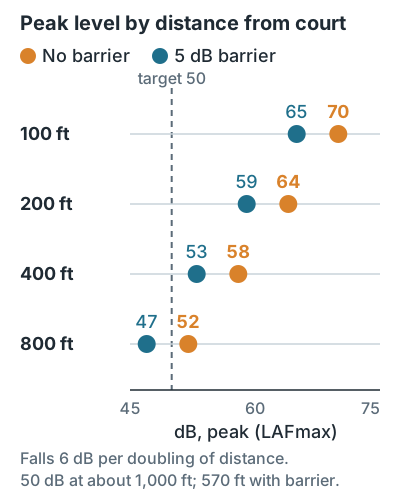
Example: Sound from a single source drops about 6 dB every time the distance doubles, which is the rule the Tucker study uses. You hit a 50 dBA target where 70 minus 6 × log2(d ÷ 100) = 50, at about 1,000 ft. Take 5 dB off with a barrier, and 65 minus 6 × log2(d ÷ 100) = 50 gives you about 570 ft.
Pickleball soundproof fence panels and wraps
Pickleball soundproof fence panels are mostly vinyl barrier blankets of about 1 lb/sq ft tied to the court's chain link. The Tucker study specified that weight, at least 6 ft tall and better at 8 ft or more. It also noted that once you go above about 14 ft, you usually need block, precast or highway-style walls instead.
Vinyl blanket
1 lb/sq ft
Reflects sound back; for example Acoustifence (opens in a new tab), 1/8 in. thick, STC 28, 6 by 30 ft rolls.
Absorptive blanket
Soft face
A barrier core with an absorbing face, so less sound bounces back across the court and out the open side.
Solid wall
Above 14 ft
Block or precast panels for heights a chain link fence can't hold up.
A sound study for Willowbrook, Illinois (opens in a new tab) recommended a wall at least 8 ft high, running down to the ground with no openings and at least 15 dB of transmission loss. It also flagged wind load as the thing to check with a fence company or engineer before you hang blankets on an existing fence.
Soundproof glass panels for courts
Glass panels block more than enough for a court barrier: 1/4 in. glass rates OITC 29 and 9/16 in. laminated glass OITC 34 (Viracon acoustic data (opens in a new tab), which recommends OITC over STC outdoors). Both are well above the 15 dB loss Willowbrook's study asked for. And they keep the view, which blankets don't.
The trouble is that glass is hard and reflective, and reflections matter on a court that's enclosed on several sides. In the Tucker study's Rosenfeld Park model, even a 16 ft barrier on all four sides left homes above the 50 dBA target because of reflections. Glass panels also need a frame built to carry their weight and wind load.
Barrier layout rules for a pickleball court
A barrier only helps the homes it hides the court from. So height, sides and gaps decide how well it works.
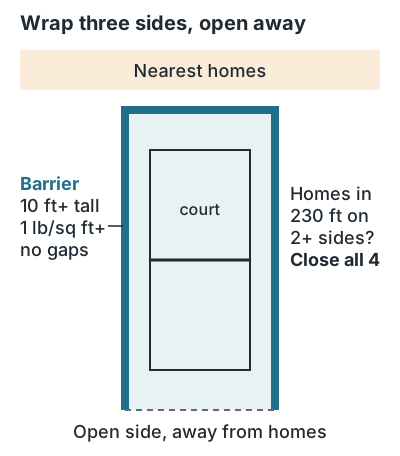
- Height: at least 10 ft (3 m) above the court. Upstairs windows sit higher: in Tucker's model a 10 ft barrier protected a backyard, but second-story windows needed 17 ft.
- Weight: at least 1 lb/sq ft. FHWA's barrier design guide (opens in a new tab) lists 1 lb/sq ft steel at 18 dB(A) transmission loss, more than the 15 dB the Willowbrook study asked for.
- Sides: three sides at the very least, and all four when homes are within about 70 m (230 ft) on two or more sides.
- Gaps: as few as you can manage. Gates, seams and the space under the blanket all leak, so overlap the seams and run the barrier to the ground.
- Length: the full length of the court area, per the Willowbrook study.
How far courts should be from homes
The BC guideline sets the distance from the court lines to the nearest residential property line needed to meet 50 dBA. A 3 m barrier cuts that distance roughly in half, except for homes with upper floors that look down on the court.
| Courts | No barrier | 3 m (10 ft) barrier |
|---|---|---|
| 2 | 65 m (213 ft) | 35 m (115 ft) |
| 4 | 90 m (295 ft) | 50 m (164 ft) |
| 6 | 105 m (344 ft) | 55 m (180 ft) |
| 12 | 160 m (525 ft) | 75 m (246 ft) |
Over grass or other soft ground the distances are shorter: 50 m (164 ft) for two courts without a barrier and 30 m (98 ft) with one. Quieter paddles and balls shrink them even more; the guideline's Table 2 puts two courts with no barrier at 35 m (115 ft) on hard ground. Keep in mind these setbacks start from an average level (LAeq 55 to 57 dBA at 15 m from one court), so they're much shorter than the peak-level distances in the Tucker figure above.
What neighbors notice after panels go up
A 5 dB drop is about the smallest change neighbors notice, and they'll still hear the game: under 5 dB is probably not noticeable, and a 10 dB drop is generally heard as half as loud (Concrete Masonry and Hardscapes Association, TEK 13-03A (opens in a new tab)).
If a home sits well inside the setback distances above, panels alone won't get you there. The Tucker draft recommended against building one park's courts as designed and suggested a covered or enclosed structure instead. The general rules for any yard barrier, from line of sight to length, are in outdoor soundproof panels.
FAQ
Do pickleball noise blankets go on the inside or outside of the fence?
Neither study picks a side. What they care about is coverage, down to the ground with no openings. If the blanket has an absorptive face, point it at the court so it soaks up sound before it bounces.
Does a roof over the courts help?
Some. The Tucker study estimated 2 to 3 dB from a fabric roof, and it suggested a covered or enclosed structure where barriers fell short.
Can a homeowner put panels on their own fence instead?
Yes, and the same rules apply from your side: hide the court from your yard and windows, at least 1 lb/sq ft, no gaps. That protects your yard, but it doesn't do much for second-floor windows that see over it.
Do hedges between courts and homes help?
A little. The Tucker study estimated up to 2 dB from a dense hedge and tree buffer at one home. You'll find more answers in the soundproof panels FAQ, and the soundproof panels guide explains why indoor-style acoustic panels don't block noise.