Soundproof Foam Panels: What They Absorb, What They Don't Block
Updated
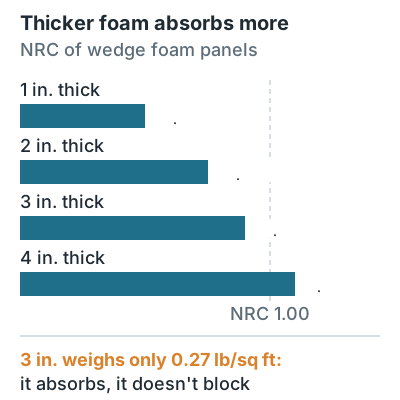
Soundproof foam panels are open-cell acoustic foam. They soak up echo inside a room (NRC 0.50 for 1 in. up to 1.10 for 4 in.), but they block almost none of the noise coming through a wall. A 3 in. foam panel weighs 0.27 lb/sq ft, about an eighth of one sheet of 5/8 in. drywall. So buy soundproofing panels foam for a room that rings, not for a neighbor you can hear.
Do soundproof foam panels block sound?
No. Foam soundproofing panels absorb the sound that hits them, so your room echoes less, but sound still goes through the wall behind them at almost the same level. Blocking takes weight, airtight seals and wall layers that don't touch. Foam brings none of the three.
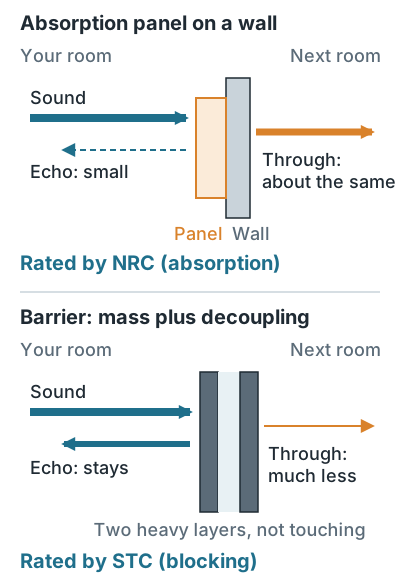
Example: Auralex's 3 in. Studiofoam Wedge weighed 0.27 lb/sq ft in its Riverbank lab report (opens in a new tab). In USG lab tests (opens in a new tab), a whole extra layer of 5/8 in. drywall (2.2 lb/sq ft) only took an insulated wall from STC 34 to 37. Foam carries 0.27 ÷ 2.2 = 12% of that weight, so it adds next to nothing.
For the short answer, plus the cases where foam is worth buying, see do soundproof foam panels work?
Acoustic foam panels for soundproofing: what thickness does
Thickness is the big thing that decides how much a foam panel absorbs. Auralex rates its wedge foam at NRC 0.50 for 1 in. and 1.10 for 4 in. (Studiofoam Wedge specs (opens in a new tab)).
NRC only averages 250 to 2,000 Hz (Acoustical Society of America (opens in a new tab)), so it hides the bass. At 125 Hz, Auralex's lab reports show 1 in. wedge foam absorbing 0.10 of the sound (1 in. report (opens in a new tab)) and 3 in. absorbing 0.23 (3 in. report (opens in a new tab)). Even 3 in. foam takes in less than a quarter of the sound at 125 Hz, so foam panels don't do much for bass.
Fiberglass board beats foam at the same thickness. The side-by-side numbers are in acoustic panels vs foam.
Wedge, flat or hexagon soundproof panels: does shape matter?
Shape is mostly about looks. Whatever the cut, thickness and the lab-tested NRC are the numbers you can actually compare.
Wedge
NRC 0.50 to 1.10
Auralex lab data for 1 to 4 in. The classic studio look.
Flat, beveled
NRC 0.90
Auralex Studiofoam Pro, 1.5 in., rated Class A for fire.
Hexagon
Ask for NRC
It's a shape, not a spec. Check its thickness and lab NRC like you would any other panel.
The Studiofoam Pro figure comes from Auralex's spec sheet (opens in a new tab), which lists 0.23 at 125 Hz. That's the same bass absorption as 3 in. wedge foam, from a flat 1.5 in. panel.
Foam density: what it tells you
Density tells you about the foam, not how well it blocks. Acoustic foam runs from 0.56 lb/cu ft for melamine (BASF (opens in a new tab)) to 1.5 to 1.7 lb/cu ft for Auralex's polyurethane wedges (3 in. lab report (opens in a new tab)). Melamine, at about a third the density, still hits NRC values of up to 1.10 (Sonex Willtec (opens in a new tab)).
Which foam is best for soundproofing has the full density and fire comparison of open-cell, melamine and closed-cell foam. Rigid closed-cell boards are a different animal; see why styrofoam panels don't work.
Fire rating: check it before foam goes on a wall
Look for a Class A rating to ASTM E84, which means a flame spread index of 0 to 25 under IBC Section 803.1.2 (WoodWorks (opens in a new tab)). Auralex lists its standard Studiofoam Wedges (opens in a new tab) as UL 94 HF-1 and gives no E84 class, while its Studiofoam Pro is rated Class A.
Watch out: In the 2003 Station nightclub fire, pyrotechnics set fire to non-fire-retarded flexible polyurethane foam lining the stage walls. Smoke reached the main entrance in a little over a minute, and 100 people died (NIST (opens in a new tab)). NIST's recommendations include banning that foam from nightclubs.
For businesses, the model building code lets foam plastic be used as interior finish when it's approved on large-scale tests like NFPA 286 (IBC 2603.9, as printed in the Seattle Building Code (opens in a new tab)). There's more on ratings in are acoustic panels fire resistant.
Hanging soundproof foam panels on walls
Put foam where sound from your voice or speakers bounces first: the side walls next to your desk or listening seat, then the wall behind you. The soundproof panels guide shows the mirror trick, and where to place acoustic panels covers whole rooms.
- Adhesive: Auralex recommends its Foamtak spray, Tubetak Pro or EZ-Stick Pro tabs for Studiofoam.
- Renters: try the adhesive on a hidden spot first, and read how to remove soundproof panels before you commit.
- Coverage: you don't need a full wall; how many acoustic panels you need has the counts.
When to buy foam panels and when to skip them
Buy foam for echo you make yourself. Skip it for noise that comes from somewhere else.
Echo on calls
Buy
1 to 2 in. foam next to and behind the desk.
Small home studio
Buy
2 to 4 in. at reflection points, plus bass traps.
Neighbor's TV or voices
Skip
Seal the gaps and add mass. Foam won't touch it.
Footsteps upstairs
Skip
That's impact noise, and it travels through the framing.
For noise between rooms, the soundproof panels guide lays out what really blocks sound: mass, decoupling, damping and sealing.
FAQ
Will foam on my side of the wall keep my music in?
No. A 3 in. foam panel adds just 0.27 lb/sq ft, so the wall lets the same sound out. Do acoustic panels keep sound out (or in)? explains why panels work the same in both directions.
Do thicker foam panels block more noise?
They absorb more. They don't block more. Going from 1 in. to 4 in. raises NRC from 0.50 to 1.10, and the panel's still way too light to change a wall's STC.
Are cheap foam packs rated?
Check the listing for an NRC and a named lab like Riverbank. If there isn't one, compare packs by thickness: Auralex's 1 in. wedge absorbs 0.94 at 2,000 Hz but only 0.13 at 250 Hz.
Is foam safe in a bedroom?
Pick a product rated Class A to ASTM E84 and keep it away from heat sources. Foam with only a UL 94 rating, or no rating at all, gives you no flame-spread number to go on. Broader safety questions are in are acoustic panels safe?, and there are more answers in the soundproof panels FAQ.