Soundproof Drywall Panels: QuietRock and the Alternatives
Updated
Soundproof drywall panels are gypsum boards with a damping polymer laminated inside. Unlike foam or fabric panels, they actually block sound through a wall. A 1/2 in. QuietRock 510 on one side of a 2x4 wall rates STC 49 in PABCO's published tests (opens in a new tab), where single stud walls of standard drywall test at STC 34 to 35. The main alternative is two layers of standard drywall with a damping compound in between.
How soundproof drywall panels work
Soundproof drywall works by damping. Two gypsum layers bonded with a viscoelastic polymer turn vibration into heat, a bit like a shock absorber on a car. The trade name for it is constrained-layer damping. National Gypsum's SoundBreak XP, for example, is "two layers of 5/16" high-density gypsum board bonded together with viscoelastic polymer" (National Gypsum (opens in a new tab)).
Damping adds blocking without adding much weight. QuietRock 510 weighs 2.1 lb/sq ft (PABCO (opens in a new tab)), about the same as the 2.2 lb of standard 5/8 in. Firecode X (USG (opens in a new tab)). PABCO's Sound Design Guide (opens in a new tab) says damped panels add isolation "without increasing the weight."
Watch out: Damping helps more with voices and TV than with bass. PABCO's own guide says "standard damped panels perform similar to standard gypsum panels at low frequencies," so subwoofers and drums still need mass and decoupling.
Soundproof drywall STC ratings
Soundproof drywall panels push a single stud wall into the high 40s and low 50s. In some builds that gets you past the STC 50 code minimum for walls between dwelling units (LADBS, IBC 1206 (opens in a new tab)).
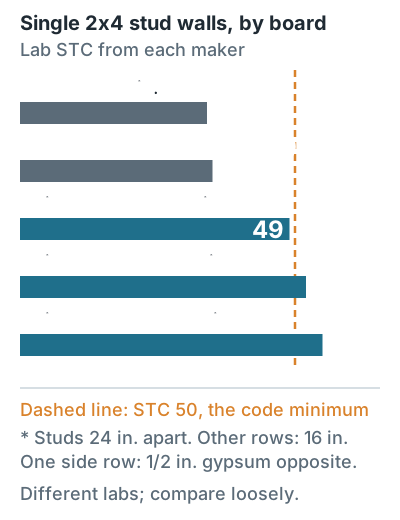
Treat these as a rough guide, not an exact gain. The QuietRock 510 walls use studs 24 in. apart and the data sheet doesn't list their insulation, while the standard walls use studs 16 in. apart. National Gypsum also warns that "field-tested values are normally lower."
QuietRock models compared
QuietRock comes in three common thicknesses, and the thicker boards add mass on top of the damping. PABCO's submittal gives each one an STC range across its tested walls, though its assembly selector also lists a 545 wall at STC 55, the one in the chart above.
| Board | Thickness | Weight | STC range in tested walls |
|---|---|---|---|
| QuietRock 510 | 1/2 in. | 2.1 lb/sq ft | 49 to 68 |
| QuietRock 530 | 5/8 in. | 3.2 lb/sq ft | 52 to 74 |
| QuietRock 545 | 1-3/8 in. | 6.2 lb/sq ft | 60 to 80 |
QuietRock 545 adds a steel sheet and a cement panel to the gypsum layers (PABCO (opens in a new tab)). A 4 × 8 ft sheet weighs about 200 lb (32 sq ft × 6.2 lb = 198 lb), so you'll want a panel lift.
Alternatives to QuietRock
There are four other ways to add blocking to a wall: another damped board, a damping compound between standard sheets, a dense fiberboard under the drywall, or mass loaded vinyl.
SoundBreak XP
STC 45 to 53
National Gypsum's damped board on one side took its staggered stud wall from 45 to 53.
Double drywall + Green Glue
2 tubes per sheet
Damping compound (opens in a new tab) between two standard sheets, screwed on within 15 minutes.
Sonopan fiberboard
3/4 in. board
A wood fiber panel that screws on before the drywall. Sonopan review
MLV under drywall
1 lb/sq ft
Limp vinyl sealed under a new layer. MLV soundproofing panels
Soundproof drywall vs double drywall with damping compound
Both methods use constrained-layer damping. The difference is where the sandwich gets made. QuietRock is laminated into one sheet at the factory, while double drywall with Green Glue builds the same sandwich right on the wall.
| QuietRock 510 | Two layers of 5/8 in. drywall + Green Glue | |
|---|---|---|
| Added thickness | 1/2 in. | 1-1/4 in. |
| Added weight | 2.1 lb/sq ft | 4.4 lb/sq ft |
| Sheets to hang per 32 sq ft | 1 | 2 |
| Extra material | None | About 2 tubes per sheet |
| Full performance | On install | Within 30 days |
The double layer is heavier and thicker, and that helps at low frequencies, where PABCO says damped boards perform like standard gypsum. QuietRock saves 3/4 in. of wall depth and one sheet of hanging per 32 sq ft, and it's the simpler retrofit. The board is a specialty item, though, so price one sheet against two standard sheets plus two tubes before you decide.
One side of the wall or both?
One side. National Gypsum says damped board is "very effective when used on one side of a wall assembly" and that adding it to both sides "does not increase the STC value enough to warrant the additional cost." PABCO's own numbers back that up: STC 49 with QuietRock 510 on one side, 52 with it on both.
Rule: Put damped board on one side, then spend the rest on sealing gaps and decoupling.
Sealing matters as much as the board does. A thin crack undoes more than you'd think. In PABCO's guide, an unsealed 1/8 in. gap 1 ft long drops a wall from STC 46 to 36, so caulk the perimeter and seal the outlet boxes. The soundproof panels guide covers decoupling and flanking paths.
FAQ
Can soundproof drywall go over existing drywall?
Yes. PABCO says QuietRock 510 can go over existing walls without demolition, and National Gypsum makes SoundBreak XP Retrofit for that job.
Does QuietRock cut and finish like normal drywall?
QuietRock 510 "installs and finishes like standard gypsum panels with no special tools required," according to PABCO. QuietRock 545 is a lot heavier at about 6.2 lb/sq ft and only comes in 8 ft lengths.
Is soundproof drywall fire rated?
QuietRock 510 has a Class A surface burn rating (flame spread 15, smoke developed 0) and is UL classified for use as an added layer in rated walls. QuietRock 545 reaches a 2-hour rating in certain single-layer walls.
Will soundproof drywall stop a neighbor's music?
It helps most with voices and the mid range. For bass, add mass and decoupling too, because damped boards perform like standard gypsum at low frequencies.
Will my finished wall match the lab STC?
Usually not quite. National Gypsum notes that "field-tested values are normally lower due to building movement and different installation methods," and the building code itself accepts STC 45 in the field against 50 in the lab. You'll find more answers in the soundproof panels FAQ.