What Is the 38% Rule in Room Acoustics?
Updated
The 38% rule in room acoustics says to put your listening seat 38% of the room's length from the front wall, where the bass is usually flattest. In a 20 ft room that's 20 x 0.38 = 7.6 ft from the front wall. The number comes from the bass trap maker RealTraps, which says it "isn't really a 'rule' as much as a starting point" (RealTraps newsletter (opens in a new tab)), and no standard sets 38%.
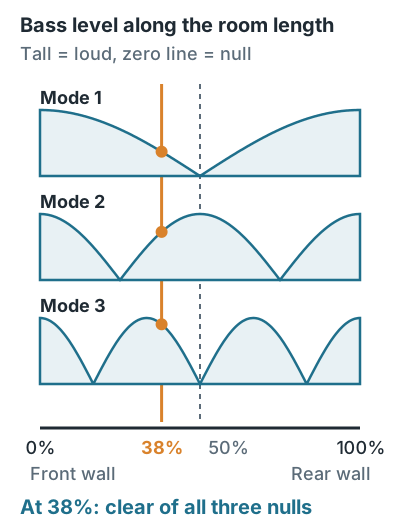
Every rectangular room has a deep bass null exactly halfway back. That's why RealTraps calls the middle "the worst place to sit" (RealTraps room setup (opens in a new tab)). GIK Acoustics (opens in a new tab) is looser about it: "about ⅜ the length of the room rather than ½." The home theater practice CEDIA/CTA-RP22 (opens in a new tab) says to keep heads out of the nulls of the 1st, 2nd and 3rd order modes, but it doesn't name a percentage.
- Face the long way: set the speakers up to fire down the length of the room.
- Multiply: room length x 0.38, measured from the front wall. If that puts you too close to a big screen, RealTraps calls 38% from the rear wall "a good second choice."
- Measure: RealTraps says it's "always best to measure the response as a final confirmation," since wall materials shift the result. If another spot reads flatter, slide the seat a few inches.
Where you sit changes which bass dips you hear, not how deep they are. Bass traps are what shrink the dips, and how many acoustic panels you need covers the count. For the rest of a listening room's layout, see studio soundproofing panels. There are more answers in the soundproof panels FAQ and the soundproof panels guide.