Should You Put Acoustic Panels Behind Speakers?
Updated
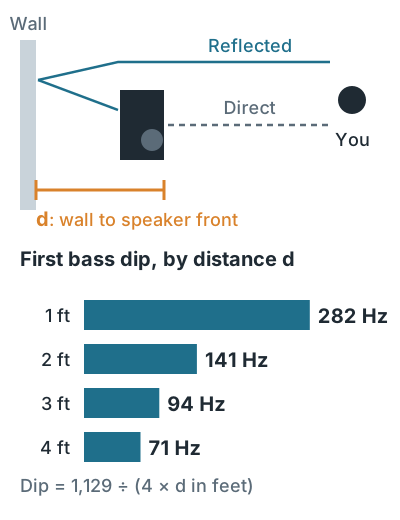
Yes, put acoustic panels behind speakers that sit more than 8 in. from the front wall, and make them 3 in. thick or more. Primacoustic recommends "a couple of 3″ thick acoustic panels behind the loudspeakers on the front wall" (Primacoustic (opens in a new tab)). Here's why: sound bouncing off that wall cancels out a band of bass, and thin panels can't reach down that low.
Genelec (opens in a new tab) puts the first dip at the speed of sound divided by four times the distance from the front of the speaker to the wall. So a speaker 3 ft out gets a dip at 1,129 ÷ (4 × 3) = 94 Hz.
Thickness decides how low a panel works: Owens Corning 703 (opens in a new tab) absorbs 5% of the sound at 125 Hz at 1 in. thick and 56% at 4 in.
Watch out: A panel alone won't fill in a dip below 125 Hz. Genelec's first fix is to flush-mount the speakers in a hard wall. If you can't, keep the speaker front under 0.6 m (2 ft) from the wall, and under 20 cm (8 in.) leaves the bass unaltered.
Treat the side-wall reflection points first and the front wall after that. How many acoustic panels you need sizes up the whole room, studio soundproofing panels lays out a full studio, and the soundproof panels guide explains why none of this keeps sound from reaching the neighbors. There are more answers in the soundproof panels FAQ.