How Far Off the Wall Should Acoustic Panels Be?
Updated
Acoustic panels work fine flush on the wall, and if you've got the room, hang them 2 to 4 in. off it: GIK Acoustics (opens in a new tab) says a gap that size "can increase low-frequency performance." So how far off the wall should acoustic panels be? GIK also says that if you have space for a gap, a thicker panel mounted flush gives better results.
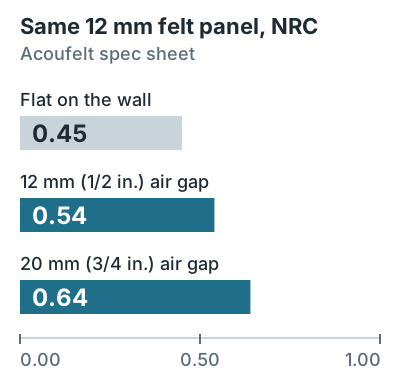
Just don't expect a gap to turn a panel into a bass trap. A 125 Hz wave is about 9 ft long (1,129 ft/s ÷ 125), so a few inches of air is a tiny slice of it. In a Politecnico di Milano study (opens in a new tab), hanging a 5 lb/cu ft (80 kg/m³) absorber panel with an 8 in. (200 mm) gap behind it only raised absorption at 125 Hz from 0.05 to 0.13.
- Thin felt panels: keep them at least 1/2 to 3/4 in. off the wall on spacers or offset clips.
- 2 in. panels: flush is fine; 2 to 4 in. off helps the low end a little.
- Bass problems: go thicker. Flush 4 in. Owens Corning 703 (opens in a new tab) absorbs 0.56 at 125 Hz, against 0.15 for 2 in.
A gap doesn't change how many panels the room needs. How many acoustic panels you need works that out, and the soundproof panels guide explains why no air gap will make a panel block noise. You'll find more placement answers in the soundproof panels FAQ.