What Is the Best Material to Block Sound?
Updated
The best material to block sound is the heaviest airtight layer you can add, built so the two sides of the wall don't touch. A single layer of 6 in. poured concrete rates about STC 55, and double walls with a big enough air space and enough drywall reach STC 60 or more (NRC Canada, CBD-239 (opens in a new tab)).
Weight on its own pays off slowly. Each time you double a single layer's weight, you only gain about 6 dB (CBD-239). Decoupling gets you more for less. That just means keeping the two faces of the wall from touching through the studs, so vibration has no direct path from one side to the other.
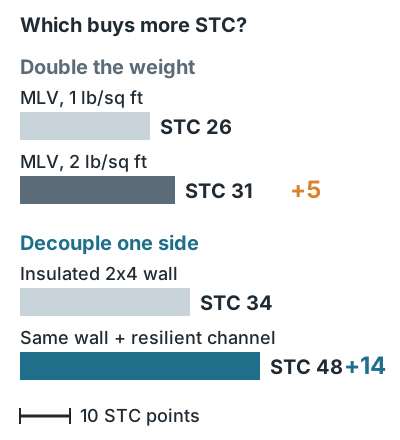
Rule: Seal every gap, add mass, then separate the two sides of the wall.
Sealing comes first because any material fails if air gets through. Sound follows the air. In PABCO's example (opens in a new tab), one unsealed 1/8 in. gap 1 ft long drops a wall from STC 46 to 36.
Foam, fiberglass and mineral wool boards don't block on their own. A 2 in. fiberglass panel weighs about 0.5 lb/sq ft (Owens Corning 703 (opens in a new tab)), under a quarter of one 2.2 lb/sq ft drywall layer. Put them inside a wall cavity, though, and they help a little: about 3 STC points on an ordinary wood-stud wall and about 8 on a decoupled one (CBD-239). Fiberglass and mineral wool soundproof panels covers both uses. What acoustic panels are made of explains the absorbing cores, the soundproof panels guide sorts every panel type into absorbers and blockers, and you'll find more answers in the soundproof panels FAQ.